
Middle Danube
Croatia, Bosnia & Herzegovina, Serbia, Hungary
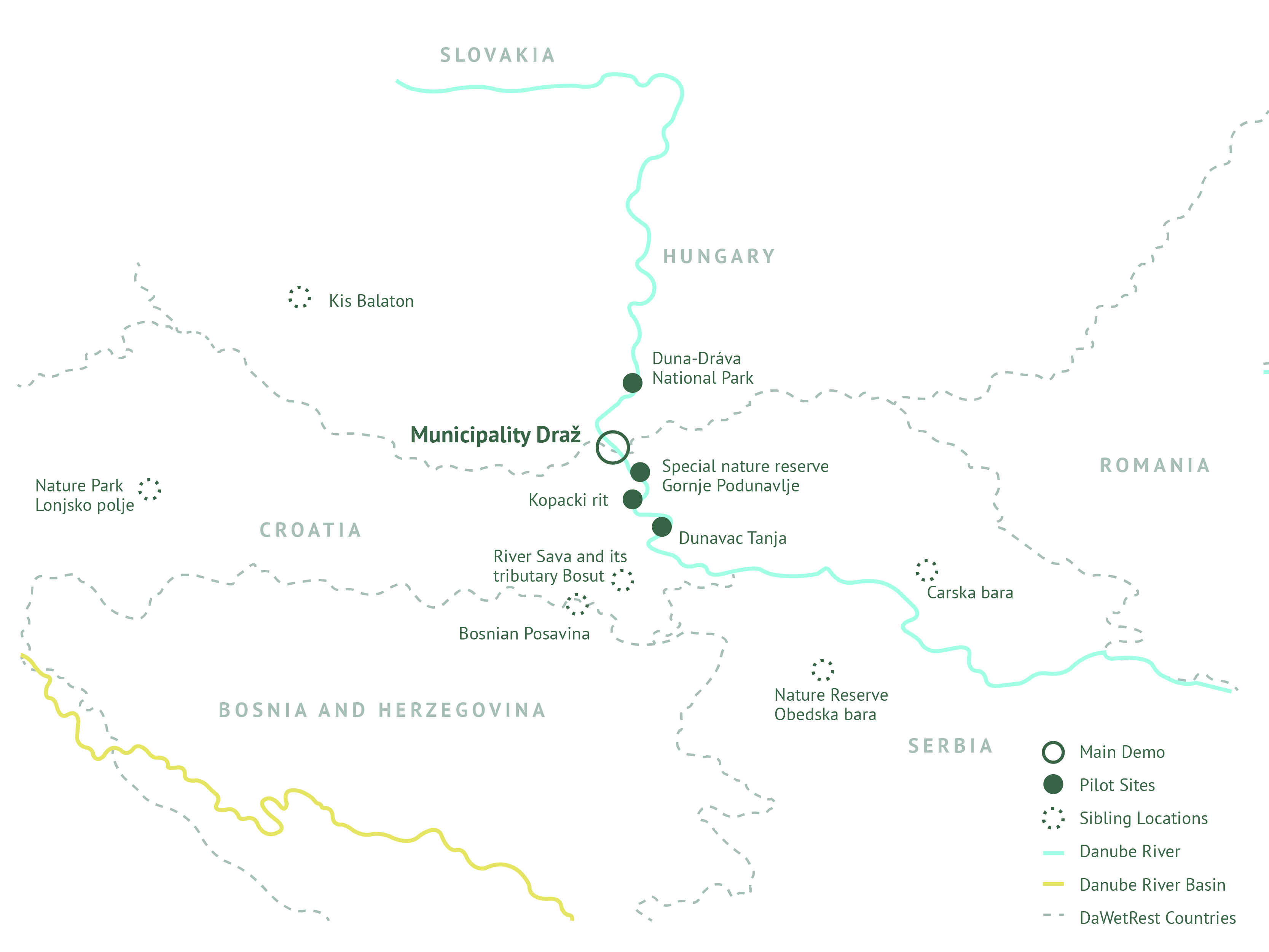
Middle Danube DEMO is dominantly located in Draž Municipality (Osijek-Baranja County) with pilot and sibling sites in Croatia, Hungary, Bosnia and Herzegovina, and Serbia. The quality of soil was the cause of early development of griculture, which was the basis for first settlements, since prehistoric times. Besides, forest-abundant areas near the Danube River as well as surrounding wetlands were the cause of favorable habitats development and high biodiversity rate. The whole demonstrator is characterised by moderate continental climate and heterogeneous reliefs, mostly low hills and large plains. Ecologically and economically important ecosystems in that area are wetlands of Topoljski dunavac, Šarkanj, Lorencov and Mačkalučki dunavac which are a part of protected ecological network NATURA 2000 classified as:
– POVS-areas of importance for the preservation of wild species and their habitats, as well as natural habitat types of interest to the European Union; (HR2001309 Dunav Sjeverno od Kopačkog rita)
– POP-areas important for preservation of wild bird species of interest for the European Union, as well as their habitats, and areas important for the conservation of migratory bird species, especially wetlands of international importance (HR1000016 Podunavlje i donje Podravlje).
Main DEMO location
Dunav S od Kopačkog rita
Pilot locations
Kopački rit
Special nature reserve Gornje Podunavlje
Dunavac Tanja
Duna-Dráva National Park, Gemenc, Hungary
Sibling locations
Nature Park Lonjsko polje
River Sava and its tributary Bosut
Bosnian Posavina
Kis Balaton
Carska bara
Actions

Hydrological works to reconnect flood plains and wetlands

Green hatchery for biodiversity improvement

Assessing carbon sequestration capacity and development of the strategy for carbon sequestration capacity increase

Monitoring of biodiversity, water, and soil quality

Mapping of critical restoration sites

Integration of the digital portal
Findings
Green Hatchery established

Strategy for the wetland improvement developed

Business model for local community developed
Challenges
In initial assessment of the area the following challenges and needs were identified:
- Lost lateral connectivity between the Danube River and lateral canals
- Decreasing biodiversity rate of targeted species
- Invasive fish species
- Damaged wood biomass in canals and forests
- Illegal fishing and hunting
- Lack of involvement of local communities into the projects for nature protection and revitalization
- Lack of holistic and transnational approach in ecological-challenges solving
- Lack of strategies for wetland improvement and their application in local communities.
Most important needs of this demonstrator are:
- Lateral connectivity improvement
- Removal of sludge from the accumulation Topoljski dunavac
- Establishment of the Green Hatchery complex for the production and cultivation of fish necessary for repopulating and biodiversity improvement
- Strong holistic and interdisciplinary approach in monitoring of targeted species
- Strategy development for future steps in ecosystem revitalization.
Innovative Solutions

Biodiversity, water and soil monitoring activities
Strategy development for wetland improvement
Business Models based on wetland potential
Green Hatchery Concept